
Article: What Was So Good About Vintage Sheets?
What Was So Good About Vintage Sheets?
There is a particular kind of old sheet that people remember.
It came from a mother or grandmother's linen cupboard. It was substantial, crisp rather than silky, smooth without being slippery, and apparently indestructible. It might already have been 20 years old when you first slept on it, yet somehow it kept going, for what seemed like forever. Why can’t you get that anymore? Can you still find “grandma’s sheets”?
The honest answer is that it’s complicated. Old sheets were often constructed very differently from many sheets sold today; some were much heavier while thread counts were generally lower. There was less expectation that cotton should feel exceptionally soft straight out of the packet. Sheets were also used, rotated, washed and dried differently. Some of what people remember is accurate, some of it is selective nostalgia and some is survivorship bias. And some of the sheets people are remembering weren’t actually what they thought they were.
And, a big reason for why today’s bedding market is full of 400, 600 and 1,000 thread count sheets promising softness and luxury - customer tastes have changed. People increasingly prefer fabrics which are lighter, softer and easier to launder.
Finally, while the variety on offer wasn’t as extensive as today, “Vintage sheets” weren't actually a single type of product. There were cheap sheets and expensive sheets, coarse-yarn muslins and fine combed percales, pure cotton and polyester blends. Some were exceptionally good, some pilled, some faded. Many wore out. So, when people remember old or vintage sheets, they’re not necessarily remembering the same thing. The common thread is simply that “they don’t make them like they used to.”
So - were sheets genuinely better in the past? Let’s start with the first question.

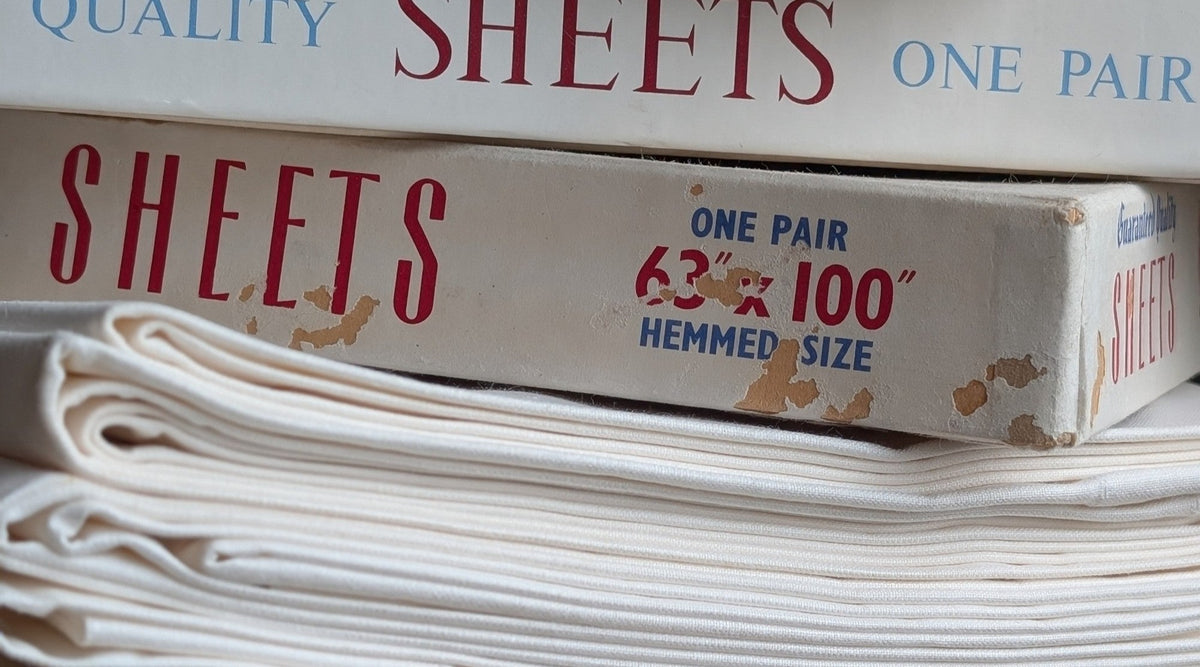
A vintage Actil sheet and original packaging insert from our collection.
What exactly were Grandma's sheets?
This is the first problem with conversations about vintage bedding.
Ask ten people what their grandmother's sheets felt like and they may be describing several quite different fabrics.
Historically, two important cotton sheet fabrics were muslin and percale. Both were plain weaves. The difference was largely in the yarn and construction.
Muslin
For much of the mid-20th century, the dominant sheeting fabric in Australia, the US, and the UK was muslin - not the fine muslin of dress fabric or gauzy baby wraps, but bed sheeting muslin, a firmly woven plain-weave cotton fabric defined by its yarn construction.
The 1963 University of Nebraska Extension Guide to Buying Sheets describes muslin as sturdy sheeting "woven of short, staple, carded yarns" with a thread count typically around 128–140 threads per square inch. The 1940 Sears (US) catalogue offered basic muslin sheets with thread counts as low as 54x62 - that's well under 120. Further up the range came finer and more closely woven muslins. The premium offering was lighter sheeting of long-staple, super-combed cotton yarns and promoted as its smoothest and best. That tells us something important - even in 1940, thickness and quality were not synonyms.
The 1971 Australian Tariff Board report on Lightweight Cotton Sheeting tells us that "practically all locally manufactured cotton sheeting weighs over 4 oz [per square yard]" - which translates to roughly 135gsm or heavier. This was the muslin-dominated market. Actil and Bradmill, the two major Australian producers, primarily made heavier construction sheeting. Fine percale was largely an imported product.
Muslin sheeting was heavier, coarser, and used thicker yarn. This is part of the reason why it lasted - not because it was the finest fabric, but because there was more material to wear through. A fabric with a thread count of 128 using heavy yarn is structurally robust in the same way a thick rope outlasts a fine cord. But durability through bulk is not the same as quality.
What muslin was not: smooth, particularly soft, or breathable in the way a fine percale is. The care instructions from a vintage Actil sheet set in our own collection tell their own story. They recommend soaking before washing, boiling for ten minutes ("washing by copper-boiling"), and rinsing multiple times. Those aren't the instructions for a delicate fine-weave fabric. They're the instructions for something substantial and robust that could take - and required - vigorous treatment.

JCPenney No-Iron Muslin: 50% polyester, 50% cotton, 130 thread count. Vintage packaging, c. late 1960s/1970s. Image cropped from an eBay listing; original photographer unknown.
Polycotton percale
By the 1970s and into the 1980s, polycotton blends had entered the market significantly. These were typically 50/50 cotton-polyester blends, sometimes 65% polyester, marketed under names like "Permanent Press" or "No Iron" - the American Sears and JC Penney 1980 catalogues are full of them - at thread counts of 180 threads per square inch, they were percale but they were partly synthetic.
These sheets had properties that pure cotton couldn't match at the time: they barely wrinkled, dried quickly, and required no ironing. They lasted well, partly because polyester is inherently durable and partly because the blend resisted the wear mechanisms that degrade pure cotton. If your memory of vintage sheets involves very little wrinkling, you may well be remembering polycotton - and sleeping in what was partly plastic without knowing it.
The "permanent press" finish that was heavily marketed in this era also relied on formaldehyde-based resin treatments to maintain shape and resist creasing. These treatments are now restricted under OEKO-TEX and GOTS certification standards due to health and environmental concerns. They worked, in the sense that they reduced wrinkling, but they did so with chemistry that is no longer considered acceptable.

JCPenney Permanent-Press Percale: 50% cotton, 50% polyester, 180 thread count. Vintage packaging. Image cropped from an eBay listing; original photographer unknown.
Fine cotton percale
There was also genuine fine cotton percale which occupied a different part of the market - 100% cotton, plain weave, 180–200 thread count, using combed yarn at higher thread counts. Described as lightweight, soft and smooth, it was a premium product but it was less common than either muslin or polycotton in the mass market, particularly in Australia.

200-thread-count 100% cotton percale by Wamsutta, JCPenney Spring/Summer Catalogue, 1992.
In the US, the JC Penney 1964 catalogue shows fine cotton percale as a premium tier: "Finest Quality 206-Count Cotton Percale Sheets" above the muslin and standard percale offerings below. By the 1980s and 1990s, cotton percale had become more mainstream, but often alongside or as polycotton.

Muslin and percale thread counts and quality tiers, JCPenney Spring/Summer Catalogue, 1964, p. 990. Source: Catalogs & Wishbooks.
This matters because people sometimes conflate all vintage sheets into one category. The muslin, the polycotton, and the fine cotton percale were very different products. The difficulty is that most people don't know which of these they're actually remembering. When someone remembers “those thick old sheets”, they may be remembering cotton sheeting muslin: relatively few, thick yarns producing a substantial fabric.
Someone else may be remembering the finer combed cotton percale sold further up the quality ladder.
And someone complaining about their sheets used to last longer and never used to wrinkle as much may not realise they may be actually remembering polyester-cotton percale, often sold as permanent press or no-iron.
Those aren't the same sheet.
Old sheets really could be extraordinarily durable
This part of the nostalgia isn't imaginary. Some old sheets clearly endured an enormous amount of use.
A great example appears in Sears' 1940 catalogue. Sears quoted a customer who said she'd used its wide sheeting to make sheets for transient roomers. According to her, the sheets had been in use for seven years and were laundered an average of twice a week.
Taken literally, that could amount to hundreds of washes.
It’s an ad, not a controlled durability test, but it shows that exceptionally hard-wearing sheets certainly existed.
Directly underneath, Sears listed three different grades of sheeting with expected lifespan of 3, 5 or 8 years respectively.
Sears Spring/Summer Catalogue, 1940. Three grades of cotton sheeting advertised with expected wear of three, five and eight years. Source: Sears, Roebuck & Co. Spring/Summer Catalogue, 1940, p. 455, via Catalogs & Wishbooks.
Notice something interesting? Even in 1940, when sheets had a reputation for being made to last, the expected advertised lifespan was measured in years, not decades. The fact that some sheets have survived for 40, 60 or even 80 years doesn't mean that was ever their normal expected working life.
Which brings us to a fairly large problem with the vintage sheets we encounter today.
We're only meeting the survivors
Imagine trying to judge the reliability of cars made in 1965 by looking only at the cars from 1965 that are still being driven.
You'd have a rather unusual sample.
Vintage sheets have the same problem.
The sheet that wore through in 1974 isn't sitting in someone's linen cupboard today. Neither is the one that tore, pilled, became badly stained, was turned into cleaning cloths or was simply used until there was nothing useful left.
The sheets that got remembered are the ones that lasted: the unusually durable sheets, lightly used guest linen, forgotten wedding presents and old stock that spent decades unopened.
It doesn't mean the survivors aren’t exceptional sheets, some clearly are.
It means they can't tell us how long the average sheet sold in their era lasted.
The Sears catalogue is particularly useful because it tells us that the sheets with a three-year lifespan existed too. They've simply had another 80 years in which to disappear and be forgotten.
Heavy didn't necessarily mean longer lasting
It would be easy at this point to reach another overly simple conclusion:
Old sheets lasted because they were thicker.
There is some logic to that because more substantial fabric gives you more material to wear through. But people who actually studied sheets at the time were already warning consumers not to think that way.
The 1963 University of Nebraska guide says explicitly that muslin was not necessarily longer-wearing than percale, and that fabric weight and tensile strength were not the only factors determining durability.
It reported a two-year hospital trial in which heavy-duty muslin wore out before fine combed percale. A separate survey of motels and institutions reportedly found muslin averaged 90–100 uses without mending, compared with 200 for percale.
The explanation was yarn quality. A good percale could use longer-staple cotton, combed to remove shorter fibres and spun into finer, more uniform yarn. The resulting fabric could be lighter and smoother yet still perform extremely well.
So GSM isn't a durability rating any more than thread count is. A heavy sheet may last a long time, but so might a light sheet. The question is less about weight and more about what the fabric is made from and how it is constructed.
We ran our own tests
We've actually purchased and sent decades old vintage cotton sheets to an independent textile laboratory to see what they were made of.
One old cotton sheet tested by AWTA weighed an extraordinary 192g/m2 (grams per square metre or GSM). Its single-ply yarn measured approximately 38-41 tex (around 15 Ne) – which is to say it was thick, coarse yarn - and the thread count was correspondingly very low at about 116 threads per square inch. Another vintage cotton sample weighed 186 gsm, again using thick single-ply yarn.
By modern bedding standards, these are very thick, substantial fabrics. Most modern sheets weigh just a fraction of that, closer to 100-120gsm. They demonstrate beautifully why thread count and fabric weight aren't the same thing. You can make a relatively lightweight sheet from lots of very fine yarns, or a very heavy sheet from far fewer thick ones.
But the laboratory results also revealed something else.
Old sheets could pill too
There is a tendency to treat pilling as evidence that modern textiles are of poor quality. Interestingly though, the lab results showed that the vintage sheets were quite susceptible to pilling too. One received a laboratory pilling rating of 3 out of 5 - and that’s after decades of washing and use. The other scored just 1 out of 5, where 5 means no pilling and 1 represents very severe pilling. We also tested some modern sheets which aim to replicate some of the old-style sheets – and the results were equally poor at just 1-2 out of 5.
That doesn't mean these old sheets necessarily spent their lives covered in pills. Pilling is affected by the fibres, yarn structure, twist, surface hairiness, fabric construction and finishing. And pilling is a process: loose surface fibres become entangled, but continued abrasion can eventually break the fibres anchoring those pills to the fabric. With 100% cotton, pills can therefore wear away as well as form. Sheets can pill badly when new, and then stabilise with decades of use which softens and wears the surface in a way that produces the smooth, comfortable texture that people remember.

We also tested tensile strength - a direct measure of how much force the fabric can withstand before breaking. The vintage muslin tested at 500 N/50mm in the warp direction and 470 N/50mm in the weft. Our own sheets tested at 731 N/50mm warp and 589 N/50mm weft - roughly 46% stronger in one direction and 25% in the other. Both tests used the same Australian Standard method (AS 2001.2.3.1), so the results are directly comparable.
This challenges another assumption about vintage sheets: that their durability came from superior strength. The heavy yarn and high GSM of old muslin gave it bulk, and bulk takes time to wear through. But the fabric itself wasn't necessarily stronger - if anything, the reverse. What made old sheets last wasn't tensile strength. It was thickness, rotation across multiple sets, and the near-universal practice of line drying rather than tumble drying.
They didn't always feel that way
There's another problem with comparing new sheets with Grandma's old ones. Cotton changes with use. Sizing and temporary finishing materials wash away. Surface fibres are removed. The fabric relaxes. Repeated washing and handling change its feel.
So when someone remembers a wonderfully smooth, substantial cotton sheet that had been in the family for 20 years, they're accurately remembering how that sheet felt - after 20 years. They probably felt nothing like that when someone first took them out of the packet.
And old manufacturers did manipulate first impressions too. The 1963 Nebraska buying guide warned shoppers about excessive sizing – starch or other substances applied to give fabric a smooth finish. It specifically warned that large quantities could be used to make a coarsely woven sheet appear finer and more closely woven than it really was. Apparently, making a fabric feel more impressive in the shop isn't an entirely modern invention!
We changed what we expect from a new sheet
There is, however, a genuine difference in the modern market - it shifted, and for reasons that reflect genuine consumer preferences, not just cost-cutting.
The 1971 Tariff Board report notes that light weight sheeting "was increasingly preferred for domestic reasons, especially because of laundering advantages." By the 1970s and 1980s, consumer preference was moving toward lighter, softer, easier-care sheets. Heavy, wet cotton is rather inconvenient! The 1963 Extension Guide describes muslin as a fabric that is "sturdy" and "economical" - but not particularly comfortable. The market wanted something that came out of the dryer without needing to be boiled, ironed, and rotated across six sets.
By the 1990s, the "thread count race" had begun - the push toward increasingly high thread counts and with it came multi-ply yarns, sateen weaves, and the inflated numbers that now dominate mainstream bedding marketing. Fabric weight went down. Thread counts went up. Softness on first touch became the primary selling point.
We expect new sheets to feel good immediately.
Soft. Silky. Washed. Relaxed. Smooth.
Few bedding companies could successfully advertise:
Quite stiff at the moment. Come back after the fiftieth wash.
Modern manufacturers have plenty of ways to alter a fabric's initial hand, including mechanical finishing, washing, enzyme treatments and softeners. And there isn't anything inherently wrong with that – after all a sheet exists to be comfortable.
But as with everything, there are trade-offs. Softer usually means finer yarn, and finer yarn means less material to wear through. Treatments like cellulase enzyme treatments, for example, are used to remove surface fibres and soften cotton, but sufficiently intensive treatment can also reduce fabric strength. A peer-reviewed study published in the International Journal of Engineering Research and Applications (Sachdeva, Suri & Bhagat, 2020) on fabric construction and longevity found that plain weave outperforms satin weave in both tensile strength retention and abrasion resistance after accelerated ageing - the tight, balanced interlacing of the one-over-one-under structure holds up better over time than the longer floats of satin, which are more vulnerable to surface abrasion and structural degradation. This is consistent with why commercial laundries have historically favoured percale over sateen, and why grandma’s sheets were the heavy muslin and plain-weave percale of earlier decades. Sateen simply doesn’t last as long.
Today's market has also been shaped by what can be sold online. A sheet that needs to be ironed every time, rotated across six sets, and broken in over a year of use before it feels good is a harder sell when reviews come in within a week of purchase. The market rewards immediate softness – that’s why sateen is so ubiquitous today - and immediate softness tends to come at the cost of longevity.
Thread count changed too
For much of the twentieth century, sheet thread counts now considered remarkably low were perfectly ordinary.
128–140 for common muslin. Around 180 for percale. Around 200 for finer percale.
And these weren't necessarily inferior fabrics. In fact, the 1963 guide described 200-count percale as the most luxurious and expensive of the common sheet constructions.

Source: Guide for Buying… Sheets, Magdalene Pfister, University of Nebraska Extension, EC63-1172, 1963.
By 1992, J.C. Penney was advertising 250-thread-count sheets on the basis of superior softness. Eventually, thread count itself became a marketing shorthand for quality.
If 200 was good, 400 sounded better. Then 600. Then 1,000.
There was an obvious problem: you can only physically pack so many conventional yarns into a square inch of useful sheeting.
One way extremely high advertised counts were produced was by counting the individual strands within plied yarn.
The US Federal Trade Commission addressed this directly. ASTM D3775 specifies that individual warp yarns and filling yarns are counted as single units regardless of whether the yarn itself is single or plied. The FTC said consumers could be misled when thread count was inflated by multiplying the actual count by the number of plies in each yarn.
So a huge number on the packet doesn't tell you how substantial the fabric is. It doesn't tell you the yarn size. It doesn't tell you the cotton quality. It doesn't tell you the fabric weight.
And it certainly doesn't tell you how long the sheet will last.
On Grandma’s sheets and wrinkles
There’s a good chance grandma’s wonderful “cotton sheets” were polycotton. Polyester-cotton bedding was everywhere from the 1970s to 1990s.
A J.C. Penney catalogue from 1980 shows 180-count cotton/polyester percale alongside 200-count all-cotton percale. The blend was explicitly promoted as easy care and requiring no ironing. By 1992, even Penney's premium 250-count “Finest Sheets” were 60% combed cotton and 40% Dacron polyester.
Old packaging in our own collection tells the same story: 180-count permanent-press percale made from 50% cotton and 50% polyester, sold on easy care and minimal shrinkage.
Polyester wasn't the only way manufacturers tackled wrinkles - cotton itself could be chemically finished for wrinkle resistance.
Permanent-press treatments traditionally used crosslinking chemistry to help cellulose retain its shape, and historical treatments commonly involved formaldehyde-releasing resins.
Again, that came with trade-offs. Traditional durable-press or permanent-press treatment can reduce cotton's tensile and abrasion strength, which is one reason textile finishing technology has continued trying to produce wrinkle resistance with less loss of strength.
So even decades ago manufacturers were balancing competing properties: wrinkle resistance, softness, strength, laundering convenience, cost and lifespan.
Today, if you choose 100% cotton without a permanent-press chemical finish - as we do - there is an unavoidable trade-off: it will wrinkle. If the remarkably smooth sheets you remember were polycotton or chemically treated permanent-press cotton, an untreated pure cotton sheet isn't going to behave the same way.
We happen to think that's a perfectly reasonable trade-off. Cotton wrinkles - this does lessen as the fibres relax with washing and use, and to us, pure cotton is far more breathable and comfortable than synthetic blends.
The Sheet changed, but so did the Laundry
Vintage sheets lasted partly because of how they were used, not just what they were made of. An old Actil care leaflet gives a fascinating glimpse into how Australian sheets were expected to be treated. It gives separate instructions for “Washing – by Copper-boiling” and “Washing – by Machine”. Its drying instructions concern pegging sheets onto a clothesline. It warns against rusty wire and tells users not to leave sheets hanging in hot sun once they are dry. There is no tumble-dryer instruction.

Vintage Actil care instructions, c. 1960s, showing directions for copper-boiling, machine washing, rinsing and line drying. From our collection.
It also tells owners:
“As the upper half of the bottom sheet gets the hardest wear, switch bottom hem to the top to equalize wear.” And its ironing instructions recommend changing the way sheets are folded occasionally, again to equalise wear. This wasn't accidental longevity. People were being explicitly instructed to distribute wear across the fabric.
The 1963 Nebraska Extension Guide gives similar advice. It recommended six sheets per bed and three pillowcases per pillow and told households that sheets would last longer if changed frequently and rotated. That is a very different use pattern from owning one or two fitted sheets and putting the same one back on the mattress every week.
And another thing which used to be common practice but hardly anyone does today - ironing. A freshly ironed cotton sheet feels completely different from an unironed one. The fibres are aligned, the surface is flat, and the crisp feel that people associate with high-quality old sheets is at least partly a function of the iron, not just the fabric. This is also why hotel sheets feel so good - they’re always pressed. Modern advice to pull sheets from the dryer slightly damp and smooth them out is a partial substitute. It's not the same.
Fitted sheets changed where the wear went
If you're washing the same fitted sheet every week, that's 52 wash cycles a year. If you're rotating across three flat sheets - bottom goes to wash, top flat moves to bottom, fresh sheet goes on top - each sheet is getting significantly less wear.
Almost no vintage sheets were fitted sheets. The fitted sheet as a standard domestic product became widespread only from the 1960s onwards. Before that, flat sheets were the norm, used top and bottom, and rotated. The consequence of the fitted sheet - apart from convenience - is that all the wear from one person's bottom goes onto one piece of fabric, repeatedly. The bottom sheet takes the harder job and is subject to the most stress.
The Nebraska guide says a sheet's hardest wear comes partly from being pulled tightly around the mattress, along with the pulling and agitation of laundering and use.
With identical flat sheets, today's top sheet can become next week's bottom sheet. The sheet can also be turned end for end, exactly as Actil recommended.
With fitted sheets, the fitted sheet is permanently assigned the high-wear job.
It's stretched over the mattress every night, under your body, taking friction in broadly the same areas. Plus elastic degrades over time much faster than the fabric.
No wonder fitted sheets so often wear out before flat sheets. That doesn't mean the fabric is worse, but we’ve assigned it a job it never has a break from.
And tumble dryers really do matter
There's good reason to think another change in domestic laundry affects sheet life too.
Tumble drying isn't mechanically neutral. US Department of Agriculture researchers studied cotton fabric dried in a household tumble dryer and found substantial fibre damage associated with heat and tumbling. Wet cotton tumbled with heat showed severe damage; overheating after the fabric was already dry caused further damage.
In other words, repeatedly drying cotton hot – and particularly over-drying it – can shorten its useful life.
While dryers were fairly widespread by the 1990s, particularly in places like the USA, in Australia the Hills-hoist tradition was still very much active and most sheets were likely to have been dried outside. The Actil instructions themselves give us useful Australian evidence: they assume clothesline drying.

Later Sheridan care instructions tell a different story: warm machine wash, warm tumble dry, remove promptly. Two care labels capture quite a lot of social history.
So if we're comparing an old sheet that spent much of its life line-dried with a modern sheet that goes through a hot tumble dryer every week, we're not running a controlled experiment in whether cotton used to be better. The fabrics are living different lives.
What about those old colours that never seem to fade?
Vintage collectors sometimes come across sheets from the 1960s, 70s and 80s with remarkably vivid colours and prints. It's tempting to conclude that dyes were simply better then - or that manufacturers were using chemicals that have since been banned.
Some historical textile chemicals and colourants are indeed now restricted, but that doesn't mean they were responsible for better colourfastness.
Modern cotton can be dyed with colourants offering excellent wash fastness, including reactive and vat dyes.
And historical colourfastness varied considerably too.
Our old Cannon muslin label explicitly advertises its colours as “colorfast”, approved by the American Institute of Laundering. The fact that Cannon considered this worth printing on the label tells us colourfastness wasn't simply taken for granted.
The 1963 buying guide makes another distinction: it says yarn-dyed colour woven into the fabric was generally very colourfast, while colours printed onto sheeting might not be.
And laundering matters here too. A later Sheridan label specifically tells owners to avoid optical brighteners except on white and not to use bleach. Yes, even labels on old sheets warn against using bleach.
Fibre content matters as well. Many of the brilliantly patterned sheets people remember from the 1970s and 80s were polyester-cotton rather than pure cotton. Polyester and cotton require different dye systems, and the polyester component of a blend can retain colour very differently from cotton. So a particularly vivid vintage polycotton print isn't necessarily evidence that cotton dyes used to be better. What survives today reflects dye chemistry, printing method, fibre content, laundering, sunlight and another dose of survivorship bias.
The badly faded vintage sheet isn't the one tempting you in the vintage shop window, it’s been cut up for rags decades ago.

Vintage Fruit of the Loom “No Iron Muslin”: 50% polyester, 50% combed cotton. Image cropped from a historical eBay listing; original photographer unknown.
Why did some old sheets last so long?
By now the slightly frustrating answer should be apparent, if unsatisfying - there wasn't one reason.
Some old sheets simply contained a large amount of cotton. Some used coarse, heavy yarn that provided plenty of material to wear through. Some fine percales used better-quality long-staple, combed yarn and achieved durability without enormous weight.
Some households owned more sheets and rotated them deliberately. Flat sheets could share the high-wear bottom-sheet job.
Care instructions explicitly taught people to turn sheets and change folds to distribute wear. Many sheets were line dried rather than repeatedly tumble dried.
And some were simply exceptionally well-made products.
Then we added one final filter: we waited 40, 60 or 80 years and looked at the ones that were still here, and concluded that meant all old sheets were simply better.
So, were vintage sheets actually better?
Some of them were excellent. Some weren't. The mistake is combining the best characteristics of several different products into one imaginary perfect sheet that never existed.
The mythical vintage sheet is thick like old sheeting muslin, fine and smooth like good combed percale, wrinkle-resistant like resin-treated polycotton, brilliantly colourfast, completely pill-free, soft from the first night - and still going strong 30 years later.
That’s asking an awful lot from one piece of fabric.
The historical evidence shows that things were a little more complicated. Sheets came at different quality levels and made different compromises, just as they do now. Sears was advertising sheets with expected lives of three, five and eight years in 1940 - not several decades. Some lightweight fine percales could outlast heavier muslin. Some sheets were wonderfully durable but prone to pilling. Some stayed smooth and relatively wrinkle-free because they contained polyester or had been given a permanent-press finish.
What has changed is partly what we choose to prioritise.
The move towards lighter sheets isn’t entirely a modern cost-cutting story. Australian records from the early 1970s show that consumers were already choosing lighter fabrics because they were easier to launder. Polycotton and permanent-press finishes reduced ironing. Finer fabrics offered a smoother feel and immediate softness. More recently, very high thread counts became shorthand for quality, while immediate softness become something a sheet could sell on from the moment a customer opened the packet.
None of those things is inherently bad. If you want a silky, lightweight sheet that feels very soft on night one, there are plenty of excellent sheets made to do exactly that.
But if what you miss is the crisp, substantial feel of traditional cotton - and you're willing to let it soften through use rather than have all of that character removed before you buy it - your options have become considerably narrower.
How to find something closer to an old-fashioned cotton sheet
First, work out which old sheet you're actually trying to recreate.
If it's the heavy, durable cotton sheeting found in some old linen cupboards - relatively low thread count, thick yarns, substantial fabric, becoming smoother with years of use - you're probably looking for something closer to traditional sheeting muslin. It isn’t particularly common in domestic bedding anymore but similar constructions can still be found through some hospitality and commercial-linen suppliers, in both cotton and polycotton.
If you remember sheets from the 1970s or 1980s that were easy-care, barely wrinkled and seemed almost indestructible, you may actually be remembering cotton/polyester percale or permanent-press cotton. Polycotton sheets are still widely available and are usually relatively inexpensive. An untreated 100% cotton sheet isn't going to behave exactly the same way: it will wrinkle.
But if what you’re looking for is the finer, cool, crisp sheet associated with good-quality old hotel or household linen, you're more likely looking for 100% cotton percale.
For traditional percale, don't shop by thread count alone. Look for 100% cotton, a plain percale weave, single-ply yarn and good-quality longer-staple cotton. Fabric weight is useful too, if the manufacturer provides it. You want enough substance to give the fabric some structure, rather than simply chasing the highest possible number of increasingly fine threads.
And don't assume heavier automatically means better. Historical buying advice made exactly this point: good-quality long-staple combed percale could be remarkably durable despite being lighter than muslin.
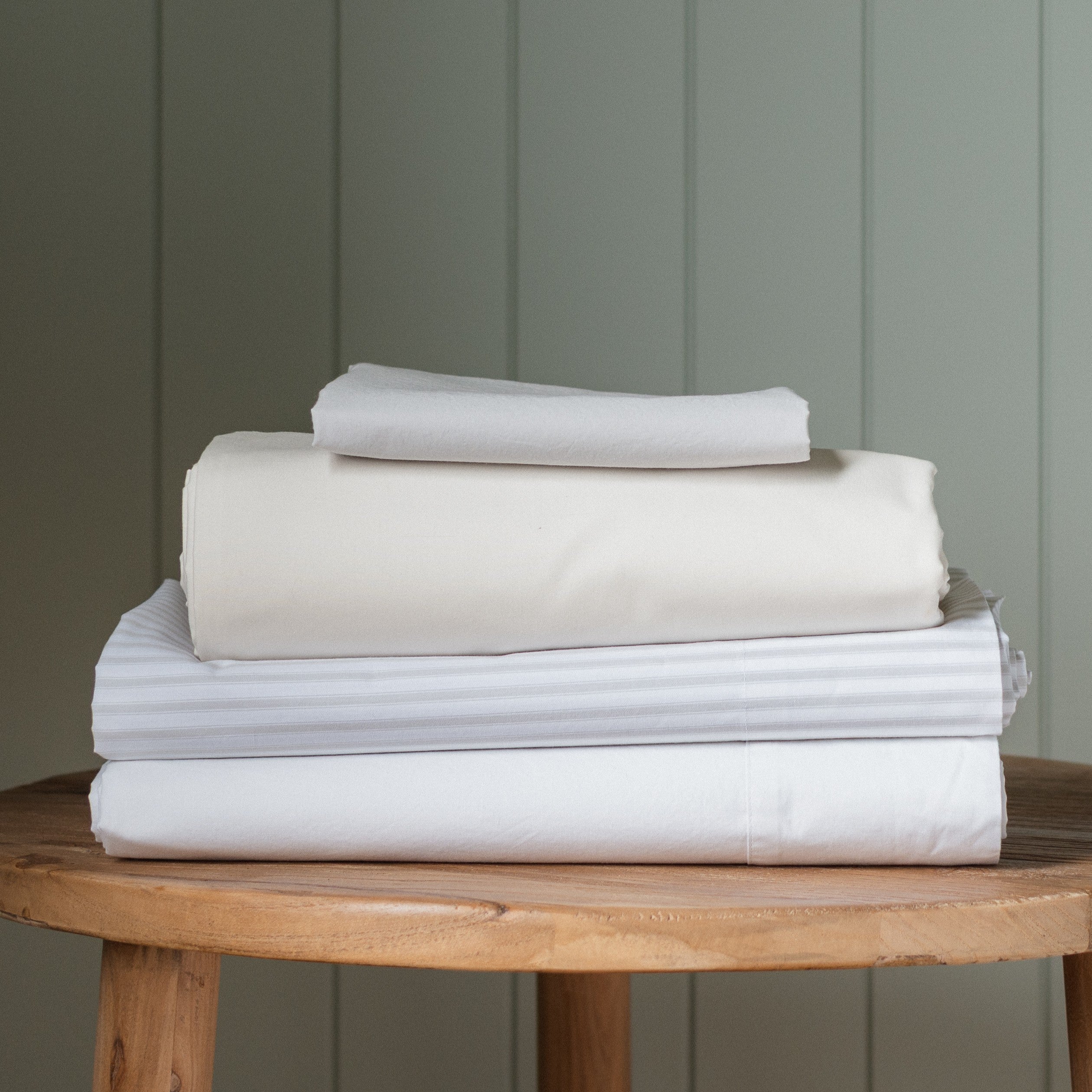
This is the particular branch of old-fashioned sheeting that we set out to recreate at The Good Sheet. Our percale is made from 100% long-staple cotton, approximately 185 threads per square inch, and with single-ply yarn. At 155 gsm it is intentionally heavier than most modern percale.
It won't feel like polycotton, and it won't be as heavy or coarse as traditional sheeting muslin. It will wrinkle. It will feel crisp and a little firm when new. It softens and becomes smoother with washing and use. And it will cost more than basic muslin or polycotton because good-quality long-staple cotton is a more expensive raw material. It won't reproduce every sheet from Grandma's cupboard, because no single fabric could.
And there's an irony here. The kind of sheet many people are now trying to find - substantial, fine, long-staple cotton percale - is probably closer to the premium end of the mid-century sheet market than to the everyday sheets many households were actually sleeping on. In the 1960s, fine combed percale was explicitly sold as the smoother, lighter and more luxurious alternative to ordinary muslin; in Australia, much of the finer lightweight percale was imported before becoming more mainstream in later decades.
So when people go looking for “sheets like Grandma had”, they aren't necessarily trying to recreate the average sheet from Grandma's linen cupboard. They're often looking for the best qualities of the better sheets from that period.
And if what you really want is the feel of a cotton sheet that had already been washed and slept in for 15 years, no new sheet can arrive with that history. That's the one part you still have to add yourself.
How to make your sheets last longer
Whichever sheets you choose, how you treat them matters as much as what they're made of.
Line dry where possible. A 1999 study presented at the American Chemical Society's national meeting found that cotton dried at high heat loses around 50% of its tensile strength after just 20 cycles. Tumble-drying without heat still causes a 24% loss. The mechanical tumbling action and heat together are hard on cotton fibres. Line drying, or drying flat, extends fabric life significantly. If you must tumble dry, use low heat and remove while still slightly damp.
Give them a break. Washing every week and immediately remaking the bed means the fabric never fully recovers between cycles. Owning two sets and alternating them - even just washing one while the other is on the bed - roughly halves the wear on each set.
Rotate where possible. Fitted sheets concentrate all the wear in one place. If you use flat sheets, rotating them - bottom sheet to wash, top flat to bottom, fresh sheet on top - spreads the wear across more fabric. If you use fitted sheets, occasionally rotating head-to-foot distributes foot wear (the most abrasive) more evenly, but you should still expect them to be one of the first items in your set to wear out.
Wash at low temperatures. High-temperature washing degrades cotton fibres faster than any other single factor in the laundry process. 40°C is sufficient for normal use. Reserve higher temperatures for genuine hygiene needs.
No chlorine bleach. It degrades cotton fibres permanently and quickly. For whitening, oxygen bleach or sunlight are significantly gentler options.
Watch the small things. Sharp edges on pegs or clotheslines, rough heels, cat claws - these create small punctures and snags that gradually widen. They look like sudden failures but have usually been developing for months.
Shop our Heavyweight Percale Bedding.